Cold works on the searches that never reach your website. A growing share of questions now get answered inside ChatGPT, Gemini, Perplexity, Copilot or Google's own AI results, and whoever gets quoted in that answer gets the recommendation. This page covers all of it: answer engine optimisation, generative engine optimisation, LLM optimisation and AI SEO are four names for substantially the same work, and anyone selling them as four services is selling you three extra invoices.
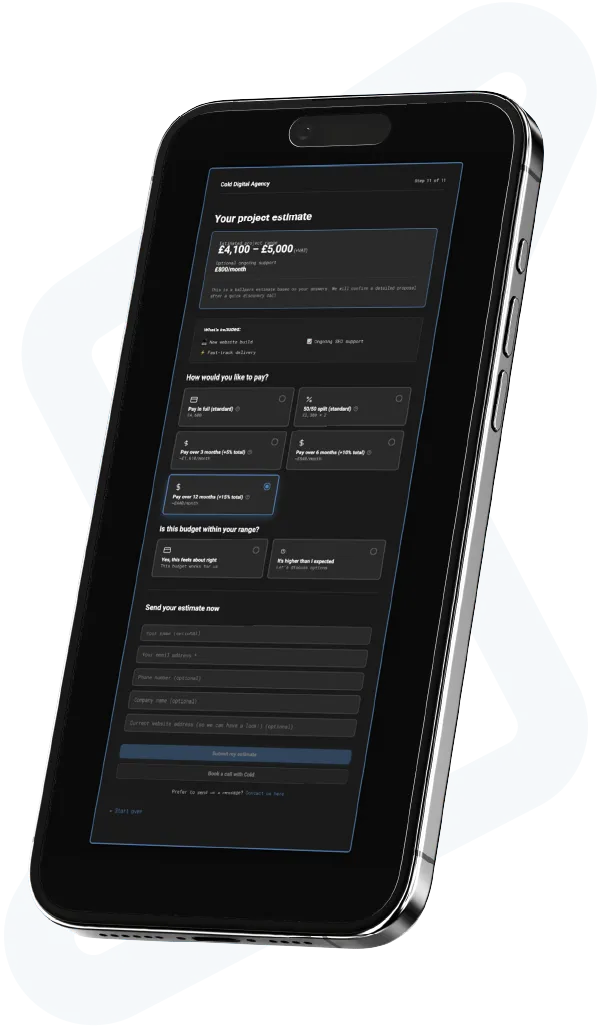
This is an instant, live ballpark quote calculator. You’ll see a project range and flexible payment options, including pay over time and monthly retainer costs.
Step 1 of 2Enter your website (or the one you’d like) to start:












The traffic you used to get for explaining things is going. Questions with a simple answer get answered in place, so impressions hold up while clicks fall, and most dashboards show that as a mysterious drop in click-through rate. Worse, the assistants are making recommendations about your market whether or not you are in them. If a customer asks which firms in Essex do the thing you do and you are not named, you never find out that the conversation happened. Nobody has a settled playbook for this yet, and the people claiming otherwise are guessing confidently.
We start by measuring it, because almost nobody is. We build a set of prompts your customers would plausibly ask across the major assistants, run them on a schedule, and record who gets named and which sources get cited. That gives you a baseline and shows where you are being left out. Then the work: pages that state answers plainly, entity and schema groundwork so the models know what you are, and presence on the third-party sources these tools quote.
Being named when someone asks an assistant for a recommendation in your market, which is the closest thing to a referral that search has produced. Fewer wasted impressions on questions that will never generate a click. And a side effect worth having on its own: the same clarity that gets a page quoted by a model tends to lift it in ordinary search too, because the two reward many of the same things.
made by











Prompts replace keywords here, and they behave differently. People ask assistants long conversational questions, often with a place, a budget or a constraint attached, and then ask follow-ups. We build a prompt set from how your customers really talk, split into the questions that lead to a recommendation and the ones that are just research, then track which of your competitors currently own each one.
Pages get written to be quotable. One question per section with the answer stated immediately underneath it, in plain language, without the four paragraphs of preamble that SEO writing picked up over the last decade. Facts stated as facts, with figures and dates. Named authors with real credentials. Models extract passages, so the unit of work is the passage rather than the page.
The technical side is about making your site machine-readable and your business unambiguous. Schema that matches the page, Organisation markup with consistent names and identifiers across the web, llms.txt and robots rules that allow the crawlers you want and block the ones you do not, clean HTML that does not hide the answer behind JavaScript, and a sitemap that reflects reality. Entity consistency matters more here than it does in classic SEO.
Local recommendations are where this is biting first. Ask any assistant for a supplier in a named town and it answers, usually by pulling from directories, review sites and map data rather than from the suppliers' own sites. So the local work is the AI work: a correct Google Business Profile, consistent details everywhere you are listed, and real reviews, because those are the sources being read.
Assistants quote third parties more than they quote you. Industry roundups, comparison articles, forums, trade publications and review platforms carry disproportionate weight, which makes getting into those lists a direct visibility job rather than a link-building one. We target the specific pages and publications that keep appearing as citations for your prompt set, which is a narrower and more useful target than general outreach.
The report shows how often you were named across the prompt set, by assistant, with the trend and the citations behind each answer. You see which competitors are being recommended instead of you and which sources the models leaned on. This is new enough that we will also tell you what we tried that did not work, because anyone presenting certainty about AI visibility right now is overselling.
Weeks one and two are measurement. We build the prompt set with you, run it across the major assistants, record who gets named and which sources get cited, and come back with a baseline nobody has given you before.
From week three we fix the groundwork: entity and schema consistency, crawler access, and rewrites of the pages closest to the questions you most want to be the answer to.
From month two we chase the citation sources and keep re-running the prompt set. You get a monthly report on how often you are named, and we adjust as the assistants change, which they do without notice.
People use assistants differently from search engines. They ask one long question, get a short answer with two or three businesses in it, and treat that as a shortlist rather than a starting point. There is no page two and no ten blue links to browse, so the difference between being named and not being named is total. The other shift is trust: a recommendation that arrives as prose reads as advice rather than as an advert, which makes it more persuasive than a top ranking and harder to buy your way into. That is good news if you are well regarded and bad news if your reputation lives entirely on your own website.

Forty second answers with no jargon. Anything else, ring the office and ask whoever picks up.
Mostly the label. AEO came from optimising for featured snippets and voice answers, GEO describes being included in generated responses, and LLM optimisation is the same idea named after the technology. In practice the work overlaps almost completely: state answers clearly, make your business unambiguous to a machine, and be present in the sources these tools quote. We run it as one service because splitting it would be selling the same work three times.
Faster than classic SEO in some cases and less predictable in all of them. Page and schema changes can appear in citations within weeks because these systems re-read the web constantly. Getting into the third-party sources they quote takes two to four months, same as any outreach. The honest answer is that the mechanisms shift without warning, so we measure monthly rather than promising a timeline.
Partly, and more than most agencies admit. You can measure how often you are named across a fixed prompt set run on a schedule, which assistants name you, and which sources they cite. What you cannot get is volume data: nobody publishes how many people asked a given question. So treat it as share of voice on a defined set of questions rather than as traffic, and be wary of anyone quoting you AI search volumes.
Retainers start from £1,000 a month, and for most clients this is part of an SEO retainer rather than a separate line. Where it sits above the minimum depends on how large the prompt set is, how many assistants we monitor and how much of the page and entity groundwork needs doing from scratch. If your schema and listings are already in order, this is a cheaper addition than people expect.
It depends on what you sell. Blocking them protects your content from being used as training material and guarantees you will not be cited either, so publishers and businesses reach opposite conclusions. If you want recommendations, you need to be readable. We usually allow the crawlers that drive citations, block the ones that only harvest, and set that out explicitly rather than leaving it to a default nobody chose.
For informational pages, yes, and the pattern is visible in most accounts we audit: impressions steady, clicks falling, worst on questions with a short factual answer. Commercial searches are holding up better, because people still want to see who they would be buying from. We can show you the split in your own Search Console data before you spend anything on this, and sometimes that shows the problem is smaller than feared.
We work with businesses in this space rather than just writing about it. Torus is an AI-powered cyber-insurance and risk-management platform, where we handled the naming, brand and build. The first fortnight ends with a baseline measurement, so you can judge the work on numbers from the start.
This work sits on top of the basics. Our on-page SEO does much of the same page-level clarity work, and the wider SEO service covers the programme around it.

Smart design decisions, great communication, and fast turnarounds, even over the Christmas break. Everything was scoped clearly, delivered on time, and they went above and beyond with extra refinements.
They delivered a professional, high-quality website and continue to provide excellent ongoing SEO support. Communication is clear, results-driven, and they genuinely understand our business objectives.
I couldn’t be happier with the outcome and highly recommend their team. I would absolutely work with them again (and likely sooner than they expect!).
They delivered far beyond what I was expecting, and I’m honestly over the moon with my new website.
The final product met all our expectations and clearly reflected their creativity, attention to detail, and dedication to delivering quality work.
We were most impressed with Cold | Digital Agency's creativity.
We're impressed with their enthusiasm for success.
They brought our identity to life in a way that felt authentic and future-focused.
Our SEO and Google rankings have improved significantly, and we’ve had a big increase in quality leads coming through the website.
They’re extremely attentive, they listened to what I wanted and brought it to life amazingly.
Superb service for my business and such a professional team.
Excellent service and really delivered on the brief I gave them. Designed the logo and my website, very happy with the result and would highly recommend.
Their whole purpose was to listen to me and deliver.
They provided professional and personalized services to suit my needs.
They consistently delivered all items on time and kept me informed throughout the process.
Overall, we were pleased with the service provided.
Cold | Digital Agency couldn't cater to my needs anymore if they tried.
I have been nothing but greatly satisfied with the work he has done for me, everything has been carefully considered and tailored to me!
They had it built much faster than I was expecting with lots of amazing features, couldn't have asked for a better site and I was very surprised at the great price for the quality they provided.
| SEO ChatGPT visibility | SEO Google AI answers | SEO Perplexity citations |
| SEO Gemini and Copilot | SEO Answer engine optimisation | SEO Generative engine optimisation |
| SEO LLM optimisation | SEO Entity and schema work | SEO Prompt set monitoring |
This is an instant, live ballpark quote, not a final proposal. It can cover branding, websites and marketing. You will see a project range and flexible payment options, including pay-over-time. Takes about 3 minutes.
Prefer to skip the calculator and ask a quick question? Drop us a line and we'll be in touch.