Cold handles the search side of moving a website. New platform, new domain, new URL structure, or merging two sites into one. The work is unglamorous and the stakes are high, because this is the project that most often costs a business a third of its traffic with nobody able to explain why.
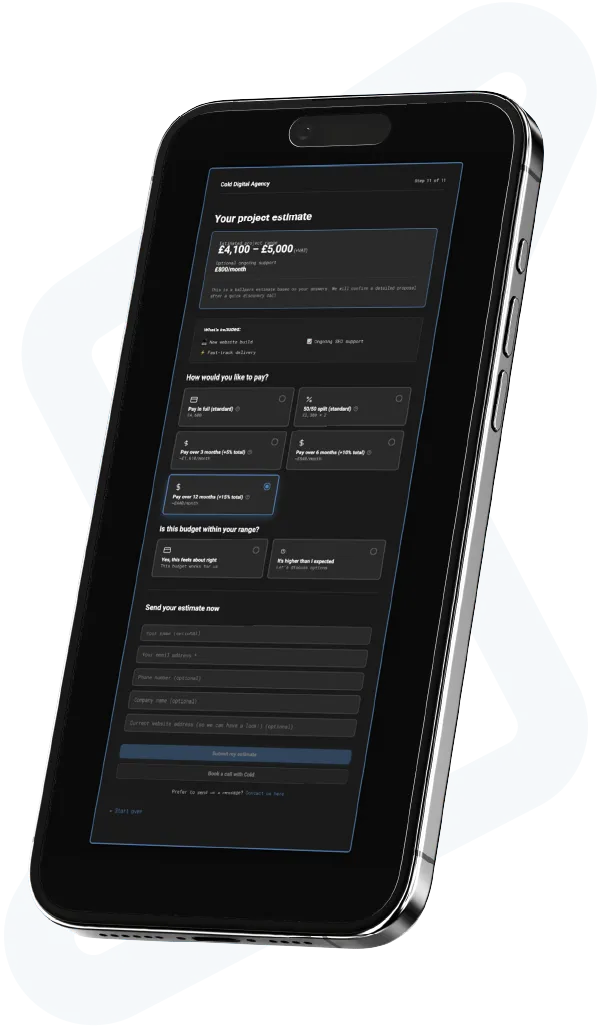
This is an instant, live ballpark quote calculator. You’ll see a project range and flexible payment options, including pay over time and monthly retainer costs.
Step 1 of 2Enter your website (or the one you’d like) to start:












Migrations fail in the same way almost every time. The redirects get done as a wildcard rule rather than URL by URL, so a thousand pages land on the homepage. Nobody measured what the old pages earned, so valuable ones get dropped for looking untidy. URLs change for tidiness and the links pointing at them stop counting. Then traffic falls over six weeks, by which point the agency has invoiced and the cause has been forgotten. The people who did it are rarely the people who find out.
We crawl the old site completely and record what every URL earns in traffic, rankings, links and enquiries. That becomes a keep, merge and drop decision per page, then a redirect map written line by line and tested on staging before launch. Launch day has a checklist. The weeks after have weekly monitoring rather than an invoice.
A migration where traffic holds and often improves, because the new site is faster and better structured. No six-week mystery decline. And a documented record of what moved where, which matters a year later when somebody asks why a URL redirects the way it does. The best version of this work is invisible: nothing happens, which is exactly what you were paying for.
made by












Before anything moves we establish what the site currently wins. Every URL with impressions, what it ranks for, and which of those rankings the business depends on. That list is the thing being protected, and without it a migration is being done on instinct. It also tends to reveal pages earning quietly that nobody internally knew existed.
Content decisions come before design decisions, which is the reverse of how most rebuilds run. Pages get sorted into keep, rewrite, merge and drop on what they earn rather than on whether they suit the new layout. Thin pages merge into stronger ones with a redirect. Pages bringing in work stay even when they are ugly, and get tidied later.
This is the core of a migration. A redirect map written URL by URL with no wildcard shortcuts, canonicals and hreflang checked on the new structure, the old sitemap kept until the new one is crawled, robots rules verified so staging does not get indexed and production does not get blocked, and analytics and conversion tracking rebuilt and tested before launch rather than after.
If you trade locally, a migration touches more than the site. Google Business Profile needs the new domain, every citation and directory listing needs updating, and schema needs rebuilding on the new templates. Mismatched details across listings are one of the commonest reasons local visibility drops after a move, and it is entirely avoidable with a list and some patience.
Your existing links are the asset most at risk. We map every page with links pointing at it and make sure those URLs resolve in one hop, not three and not to a 404. Where a page is being retired, the links decide where it points. For the most valuable links it is worth contacting the site and asking them to update the URL directly, which we do.
Reporting during a migration is weekly rather than monthly, because the window where a problem is cheap to fix is short. Index coverage on the new URLs, redirect errors, rankings on the pages that matter and enquiries against the same period before the move. We keep that running for two months, then it settles into normal reporting.
The first week is measurement. We crawl the existing site, pull its rankings, links and enquiry data, and produce the list of what the migration has to protect before any decisions get made.
Then the mapping. Every old URL gets a destination, written individually, and we test the whole map on staging along with robots rules, canonicals, schema and tracking.
Launch runs to a checklist, then we monitor weekly for two months: index coverage, redirect errors, rankings and enquiries against the same period before the move.
Nobody plans a migration around search, which is how the damage happens. The timeline is set by the brand launch, the platform contract or the financial year, and the search work gets fitted into whatever is left. The useful question when hiring for this is when the supplier wants to be involved. Anyone happy to start the week before launch is selling you a redirect file rather than a migration. The honest answer is that the work should begin while the new site is still being designed, because the decisions that cost you traffic are made then, not on launch day.

Forty second answers with no jargon. Anything else, ring the office and ask whoever picks up.
Expect a short wobble and not a decline. Google has to recrawl and reassess thousands of URLs, so positions move about for two to four weeks before settling. A migration done properly comes back level or better, because the new site is usually faster and better structured. The lasting losses come from missing redirects, dropped pages and changed URLs, which are all avoidable rather than inevitable.
While the new site is still being designed, because that is when URL structure and content decisions get made and those are what cost you traffic. Involve us the week before launch and we can reduce the damage rather than prevent it. Involve us after launch and we are reconstructing a redirect map from archive crawls, which works but costs more and recovers less.
It can be a fixed project or part of a retainer starting from £1,000 a month. The drivers are how many URLs are moving, whether the platform and the domain are both changing, and how much of the content needs decisions rather than copying. A 200-page brochure site is a short job. A catalogue with years of discontinued products is a substantial one.
The search work runs three to six weeks before launch for most sites, then two months of monitoring afterwards. Week one is measurement, the following weeks are mapping and staging tests. A large catalogue or a site consolidation runs longer. The limiting factor is usually how early the new site is available on staging, since the map cannot be finished against pages that do not exist yet.
Yes, and it is the move we see most often, usually to Webflow or to Next.js with a headless CMS. We handle the search side either way, and we can do the build too. The content export is rarely as clean as people expect, so part of the first week is working out what the data really looks like rather than what the admin screen suggests.
Then we find out why, which is why the monitoring is weekly rather than monthly. Most post-launch drops have a traceable cause: a redirect missed, a template blocking indexation, a page removed that was earning more than anyone realised, or tracking misreporting a decline that has not happened. Caught inside a fortnight these are nearly all recoverable. Caught after six months, some are not.
We have moved sites between platforms and kept the rankings. Tasito Despatch in Basildon moved to Next.js with Sanity as part of a brand and site redesign with SEO alongside it. AB Mortgages came with a redesign, development, SEO and location pages together, and I&S Construction was a redesign with a new CMS behind it.
If the rebuild itself is in scope, our website redesign covers that, and technical SEO picks up the site once it has landed.


Smart design decisions, great communication, and fast turnarounds, even over the Christmas break. Everything was scoped clearly, delivered on time, and they went above and beyond with extra refinements.
They delivered a professional, high-quality website and continue to provide excellent ongoing SEO support. Communication is clear, results-driven, and they genuinely understand our business objectives.
I couldn’t be happier with the outcome and highly recommend their team. I would absolutely work with them again (and likely sooner than they expect!).
They delivered far beyond what I was expecting, and I’m honestly over the moon with my new website.
The final product met all our expectations and clearly reflected their creativity, attention to detail, and dedication to delivering quality work.
We were most impressed with Cold | Digital Agency's creativity.
We're impressed with their enthusiasm for success.
They brought our identity to life in a way that felt authentic and future-focused.
Our SEO and Google rankings have improved significantly, and we’ve had a big increase in quality leads coming through the website.
They’re extremely attentive, they listened to what I wanted and brought it to life amazingly.
Superb service for my business and such a professional team.
Excellent service and really delivered on the brief I gave them. Designed the logo and my website, very happy with the result and would highly recommend.
Their whole purpose was to listen to me and deliver.
They provided professional and personalized services to suit my needs.
They consistently delivered all items on time and kept me informed throughout the process.
Overall, we were pleased with the service provided.
Cold | Digital Agency couldn't cater to my needs anymore if they tried.
I have been nothing but greatly satisfied with the work he has done for me, everything has been carefully considered and tailored to me!
They had it built much faster than I was expecting with lots of amazing features, couldn't have asked for a better site and I was very surprised at the great price for the quality they provided.
| SEO Platform moves | SEO Domain changes | SEO URL restructures |
| SEO Redirect mapping | SEO Site consolidations | SEO HTTPS and subdomain moves |
| SEO Pre-launch staging checks | SEO Tracking rebuilds | SEO Post-launch monitoring |
This is an instant, live ballpark quote, not a final proposal. It can cover branding, websites and marketing. You will see a project range and flexible payment options, including pay-over-time. Takes about 3 minutes.
Prefer to skip the calculator and ask a quick question? Drop us a line and we'll be in touch.